






Articles
Behind-the-scenes supply chains make or break a company
Premium content from Business Courier by Jon Newberry, Staff Reporter
Date: Friday, November 4, 2011, 6:00am EDT
Related:
Manufacturing, Logistics & Transportation, Economic Snapshot
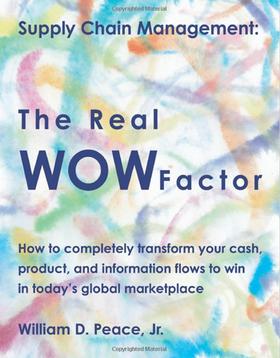
This book on supply chain management was written by a veteran supply chain executive with the Procter & Gamble Co.
Jon Newberry
Staff Reporter - Business Courier
The common denominator among Boeing's 787 Dreamliner, Japan's Tohoku earthquake and tsunami, and Procter & Gamble Co.'s $57 billion acquisition of Gillette?
Two words: supply chains.
The first 787 airliner was finally delivered to All Nippon Airways in late September, more than three years behind schedule. Boeing is still negotiating penalties wrought by the many delays.
Japan's earthquake caused more than $200 billion in damages based on a World Bank estimate, making it one of the costliest natural disasters ever. Six months later, people at Toyota's U.S. manufacturing headquarters in Erlanger were still grappling with the disruptions it triggered in their production schedules.
P&G's merger with Gillette, meanwhile, transformed the world's largest consumer products company.
The unifying element of all three examples is the importance of supply chains in today's global marketplace. And now a veteran P&G supply chain executive, William Peace Jr., has written a book designed to pass on some of the secrets to P&G's success in the field.
"Supply Chain Management: The Real WOW Factor" details Peace's experiences from the early 1990s through his role in leading the supply chain portion of the Gillette integration from 2005 until his retirement in 2007.
Because P&G sold off or shut down the last of its significant local manufacturing operations a decade ago, it's easy to forget the company is a major manufacturer all over the globe and that a huge part of its business is making things and getting them into the hands of the world's consumers.
That's basically what supply chain management is all about, and Peace tries to convey how P&G has not only made that process more efficient but transformed it into a core competitive advantage.
"My objective here is not only to share a bit of history with the different stages of P&G's supply chain evolution, but also to outline how your business can benefit from the material as you reinvent your own supply chain," he writes.
Much of Peace's book is about how to deal with customers and the creation of a "consumer-driven supply network."
The latter is referred to as CDSN, an example of the many acronyms he uses throughout the book. In fact, readers who aren't versed in supply chain lingo (and maybe those who are) would be well-advised to remove Peace's several glossaries of acronyms included in the book and keep them handy as a pull-out reference.
Steve Rogers is another retired P&G supply chain veteran who wrote a book in 2009 about lessons he learned from P&G and other companies, "The Supply-Based Advantage." It focuses on the supplier end of the chain – note, however, that Peace prefers to look at the process as a closed loop rather than a chain of events – and how to use suppliers to build a competitive advantage.
"One of the struggles a lot of companies have, once they get to several hundred million dollars, is that it's no longer one guy's company," Rogers said. "It gets really hard to see across the entire supply chain from end to end."
Rogers retired from P&G in 2003 after 30 years and is now an executive professor in Xavier University's MBA program and a consultant with Cincinnati Consulting Consortium, a group of ex-P&G'ers who advise other businesses.
If a company wants to build a competitive advantage, buyers need to engage with suppliers to build relationships that benefit both of them, he said. He cites numerous key innovations that P&G developed with its suppliers, including in-mold labels for plastic bottles with Cincinnati-based Multi-Color Corp., the chemical cleanser in Mr. Clean Magic Erasers it got from BASF, and the fold-up plastic handles for its Swiffer mops which it developed with a Hong Kong-based supplier to the toy industry.
"You have to work the relationship side pretty hard," Rogers said, because then suppliers will bring you their innovations, and both companies can prosper as a result.
"If we hadn't gone and asked the toy guys (about Swiffer handles), it would have taken us another couple years to figure out how to do it," he said. "A supplier can really help you."
